
Panthéon tours and tickets
France laid its writers, scientists, and thinkers to rest beneath this dome where Foucault’s pendulum sways.
Hours of operation
10:00 AM to 6:00 PM or 6:30 PM seasonally.
Ticket required
Free for select groups.
Best time to visit
At opening or in the late afternoon.
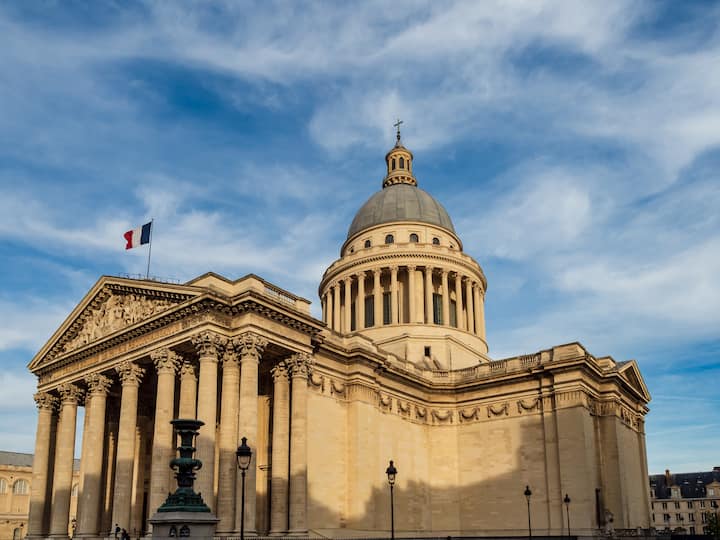
About the Panthéon
Originally commissioned as a church by King Louis XV, the Panthéon was repurposed into a secular monument during the French Revolution. Its crypt holds more than 70 of France’s greatest citizens, including Victor Hugo, Marie Curie, and Voltaire. Beneath its dome, a replica of Foucault’s Pendulum still traces the Earth’s rotation.
Top highlights for your visit

The crypt
More than 70 of France’s most revered figures are buried in the underground crypt, including Victor Hugo, Marie Curie, Voltaire, Jean-Jacques Rousseau, Josephine Baker, and Simone Veil.

Foucault’s pendulum
A working replica of the famous pendulum, installed in 1851, swings continuously from the center of the dome, demonstrating the rotation of the Earth in real time.

The dome panorama
For a small supplemental fee, visitors can climb 206 steps to the upper colonnades for a 360-degree view of the Paris skyline, from April to October.

The nave and frescoes
The main floor showcases sweeping neoclassical architecture and detailed frescoes, reflecting the building’s original design by architect Jacques-Germain Soufflot, who began construction in 1758.
Panthéon FAQs
What is the origin of the Panthéon in Paris?
The Panthéon was originally commissioned by King Louis XV as a church dedicated to Saint Geneviève. When the French Revolution arrived, the neoclassical building took on a new purpose as a secular monument to France’s greatest citizens. Inside, you’ll also find a working replica of Foucault’s Pendulum, first installed in 1851 to demonstrate the Earth’s rotation.
Who is buried in the Panthéon?
Beneath the Panthéon is an underground crypt that serves as the final resting place for more than 70 of France’s most celebrated figures. Here, you can pay your respects to writers, scientists, and thinkers who shaped history, including Victor Hugo, Marie Curie, Voltaire, Jean-Jacques Rousseau, Josephine Baker, and Simone Veil.
Is free admission available?
Yes, admission is free for visitors under 18, European Union residents between 18 and 25, and guests with disabilities along with one companion.
Can you go to the top of the Panthéon dome?
Yes, and it’s a worthwhile climb. From April through October, you can make your way up 206 steps to the upper colonnades of the dome, where you can take in a 360-degree view of the Paris skyline. Accessing the panorama requires a small supplemental fee and comfortable walking shoes.
How old is the Panthéon?
The Panthéon was designed by architect Jacques-Germain Soufflot and built between 1758 and 1790. It was completed at the start of the French Revolution, and the new government quickly transformed the building from a royal church into a national monument.
Are guided tours available?
The monument offers 45-minute guided lecture tours in both French and English at 2:00 PM and 3:00 PM, included with your admission ticket. You can also rent an audioguide or pick up a free visitor guide, available in 11 languages.
Is the Panthéon accessible for visitors with disabilities?
The Panthéon welcomes all visitors and offers free admission for guests with disabilities and one companion. The main nave is fully accessible to wheelchair users via a fixed exterior ramp and an interior lifting platform. Because of the historic nature of the building, the underground crypt and upper dome can only be reached by stairs.
How long should I plan to spend there?
Most visitors find that 60–90 minutes gives them plenty of time to explore the sweeping nave, watch Foucault’s Pendulum in motion, and wander through the crypt. The audioguide offers a more in-depth 90-minute tour of the site.
Things to know before visiting the Panthéon
Entry and access
- Discounted admission is available on Wednesdays from April to September.
- Admission is free for visitors under 18, and EU residents aged 18 to 25.
- The Panthéon is open daily from 10:00 AM to 6:00 or 6:30 PM seasonally.
Dress code
- Wear supportive walking shoes, especially if you plan to climb the steps to the dome.
- Bring a light layer, as the stone crypt can feel cool even in summer.
- Large bags and suitcases are not permitted. Travel as light as you can.
Additional information
- The main nave is wheelchair accessible via a ramp and interior lifting platform.
- Expect a mandatory security bag check at the entrance.
- Personal photography is welcome. Tripods are not permitted inside.